01 A Friend in Need
oil on canvas, 1903
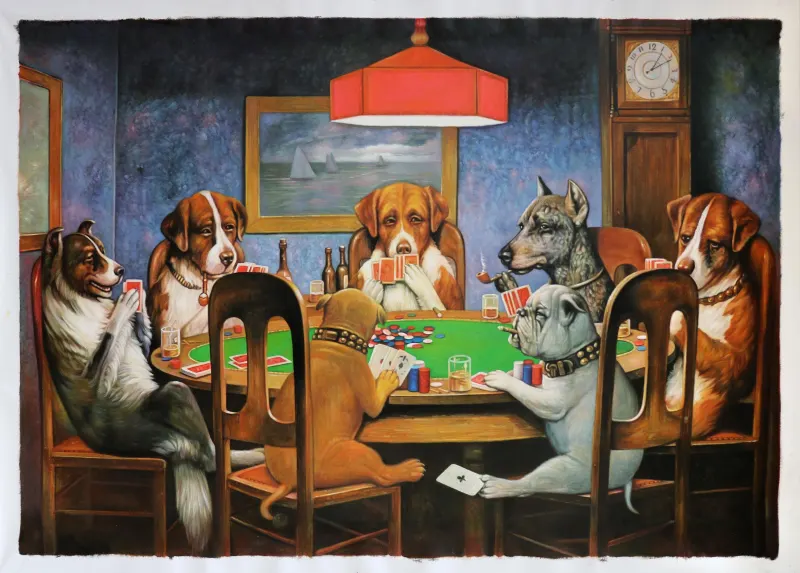
The painting almost everyone means when they say "dogs playing poker." A bulldog at the front of the table slides an ace to his neighbor under the felt. The whole series turns on this one tableau — once it landed in calendar form in cigar shops, the format was fixed.
Critics later read it as a small parable about working-class loyalty; Coolidge probably just liked the joke. The composition borrows from 17th-century Dutch tavern paintings, which is the kind of fact that gets you in trouble at dinner parties.
02 His Station & Four Aces
oil on canvas, 1903
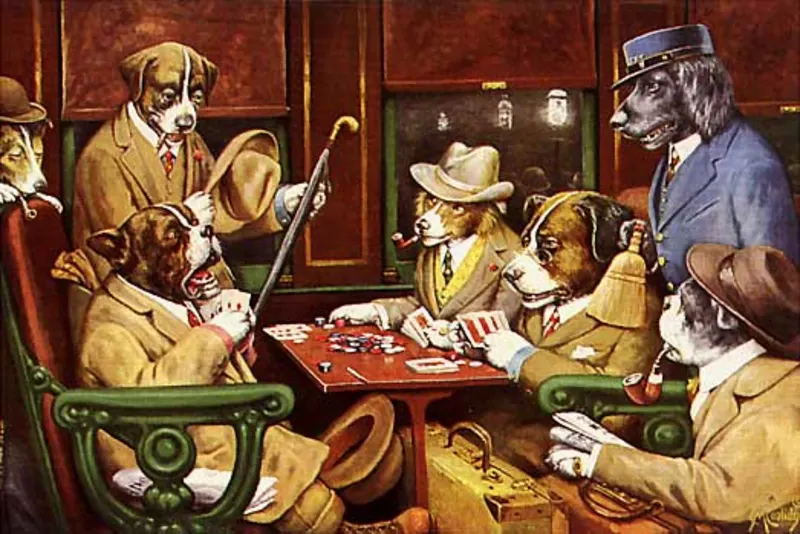
A railway conductor dog interrupts the game to call a station stop while one of the players is holding the highest possible four-card hand. The setup is the joke: the universe arranges its worst possible timing.
Coolidge worked the train-station beat in three of the sixteen paintings — this is the most polished of them. Look at the lantern light; he was a better technician than the calendar format ever let on.
03 Pinched with Four Aces
oil on canvas, 1903
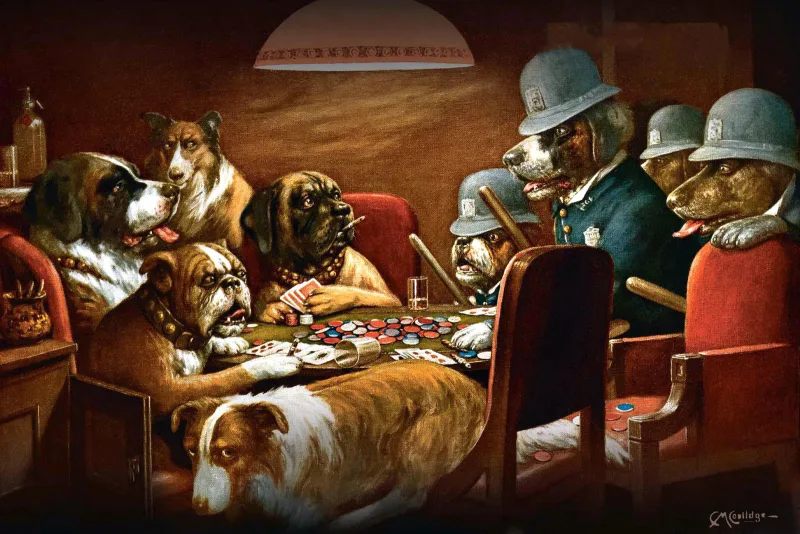
Police raid mid-hand. The arrested dog is holding four aces. It's the second "worst timing" painting of the series and runs on the same engine as His Station.
Calendar-shop staff in 1903 reportedly favored this one because the visual gag reads from across a room — a useful property when you're trying to sell cigars off the same wall.
04 Poker Sympathy
oil on canvas, 1903
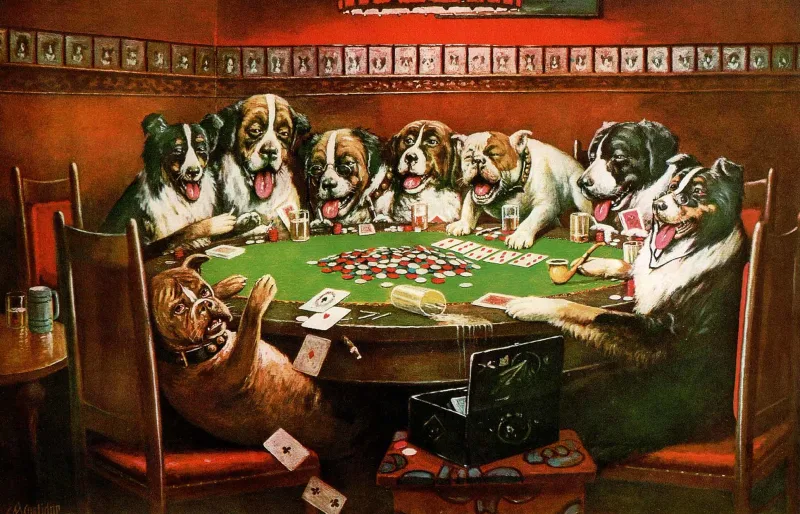
A losing player buries his head in his paws while the rest of the table looks on with mock-condolence. The most emotionally legible painting of the series — every dog is doing something specific with its face.
05 Post Mortem
oil on canvas, 1903
The hand is over. Cards are face-up on the table. The dogs are reconstructing what just happened — who folded too early, who should have raised. It's the quietest painting in the poker subset and the one most often overlooked.
Source archive pending. This painting is public domain (published before
1929 in the United States), but a high-resolution scan has not yet appeared in open public
archives. The original is held in private collection or the Brown & Bigelow corporate
archive. We do not generate AI substitutes for Coolidge originals.
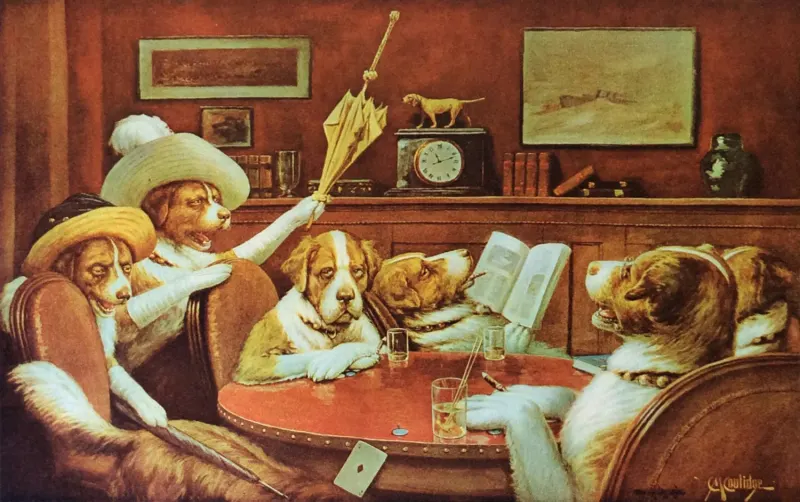
06 Sitting Up with a Sick Friend
oil on canvas, 1905
The setup is purely titular: a group of dogs has supposedly gathered to nurse a friend through a fever. They are instead playing poker. The fiction is for the wives — Coolidge knew his audience.
This is the painting most directly aimed at the calendar's male buyer. It hung in barbershops and lodge halls for forty years.
07 A Waterloo
oil on canvas, 1906
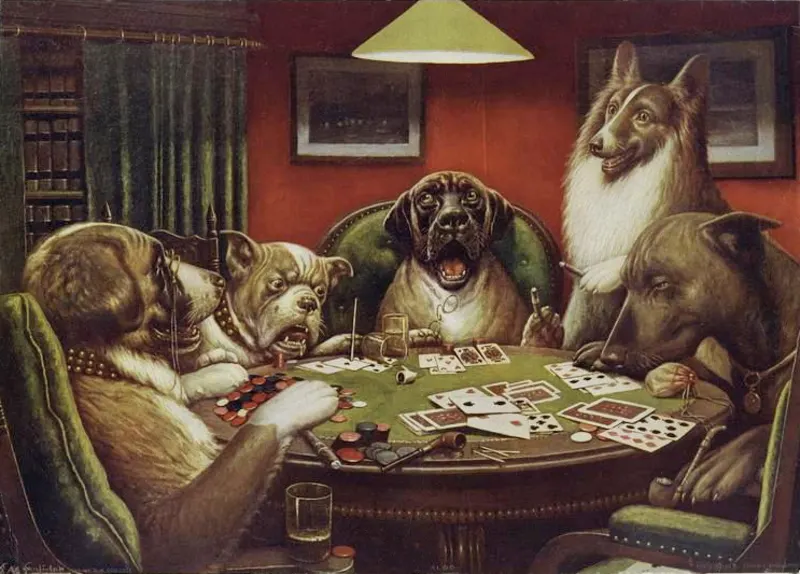
The pair piece to A Bold Bluff. The bluff has been called; the bluffer's losing hand is exposed. The two paintings were sold together at Sotheby's in 2005 for $590,400 — the highest auction price the series has ever recorded.
08 A Bold Bluff
oil on canvas, 1909
The setup half of the Sotheby's pair. A St. Bernard at the center of the table runs a confident bluff on a pair of twos. The cigar is doing real compositional work — Coolidge uses it to point the viewer's eye at exactly the spot the painting needs.
Source archive pending. This painting is public domain (published before
1929 in the United States), but a high-resolution scan has not yet appeared in open public
archives. The original is held in private collection or the Brown & Bigelow corporate
archive. We do not generate AI substitutes for Coolidge originals.
09 Looks Like Four of a Kind
oil on canvas, 1910
The final poker painting of the commission and the last Brown & Bigelow Coolidge of any kind. The brushwork is looser here than in the 1903 batch; he was sixty-six and the calendar business was already moving toward photography.
Source archive pending. This painting is public domain (published before
1929 in the United States), but a high-resolution scan has not yet appeared in open public
archives. The original is held in private collection or the Brown & Bigelow corporate
archive. We do not generate AI substitutes for Coolidge originals.
♣ Everywhere Else
Seven paintings the public almost never sees. The dogs go to court, ride the lodge goat, throw a
New Year's Eve party, attend a baseball game, camp, reunite, and break down on a country road.
10 Breach of Promise Suit
oil on canvas, 1903
A small dog testifies, a witness box, a judge. Breach-of-promise suits — the now-defunct civil action for being jilted at the altar — were a sensational news category in 1903. The painting was a topical joke that has, predictably, aged into obscurity.
Source archive pending. This painting is public domain (published before
1929 in the United States), but a high-resolution scan has not yet appeared in open public
archives. The original is held in private collection or the Brown & Bigelow corporate
archive. We do not generate AI substitutes for Coolidge originals.
11 New Year's Eve in Dogville
oil on canvas, 1903
The largest painting in the series by canvas count of figures. A formal ballroom mid-toast. The composition is harder than anything in the poker subset and rarely gets credit for it.
Source archive pending. This painting is public domain (published before
1929 in the United States), but a high-resolution scan has not yet appeared in open public
archives. The original is held in private collection or the Brown & Bigelow corporate
archive. We do not generate AI substitutes for Coolidge originals.
12 Riding the Goat
oil on canvas, 1905
"Riding the goat" was a euphemism for the fraternal-order hazing ritual that Freemasons, Odd Fellows, and Elks ran on new members in the late nineteenth century. Coolidge was a lodge member himself.
Source archive pending. This painting is public domain (published before
1929 in the United States), but a high-resolution scan has not yet appeared in open public
archives. The original is held in private collection or the Brown & Bigelow corporate
archive. We do not generate AI substitutes for Coolidge originals.
13 One to Tie, Two to Win
oil on canvas, 1906
Two outs, bottom of the ninth. Dogs at the plate, dogs in the dugout, dogs in the bleachers. The only sports painting in the series and the only outdoor daylight scene.
Source archive pending. This painting is public domain (published before
1929 in the United States), but a high-resolution scan has not yet appeared in open public
archives. The original is held in private collection or the Brown & Bigelow corporate
archive. We do not generate AI substitutes for Coolidge originals.
14 A Stranger in Camp
oil on canvas, 1909
A backwoods hunting camp at night. A new dog has arrived at the fire. Of the seven non-poker paintings this is the most painterly — the firelight pulls all the work, and Coolidge lets it.
Source archive pending. This painting is public domain (published before
1929 in the United States), but a high-resolution scan has not yet appeared in open public
archives. The original is held in private collection or the Brown & Bigelow corporate
archive. We do not generate AI substitutes for Coolidge originals.
15 The Reunion
oil on canvas, 1903
A parlor scene of old friends, cigars, brandy, no cards. The closest the series gets to portrait work — each dog reads as a specific individual rather than a type.
Source archive pending. This painting is public domain (published before
1929 in the United States), but a high-resolution scan has not yet appeared in open public
archives. The original is held in private collection or the Brown & Bigelow corporate
archive. We do not generate AI substitutes for Coolidge originals.
16 Ten Miles to a Garage
oil on canvas, 1909
A motor car has broken down on a country lane. The painting captured the precise cultural moment when automobiles had become common enough to break down but not yet common enough to fix oneself. Coolidge's only automobile painting and the most-dated of the sixteen.
Source archive pending. This painting is public domain (published before
1929 in the United States), but a high-resolution scan has not yet appeared in open public
archives. The original is held in private collection or the Brown & Bigelow corporate
archive. We do not generate AI substitutes for Coolidge originals.